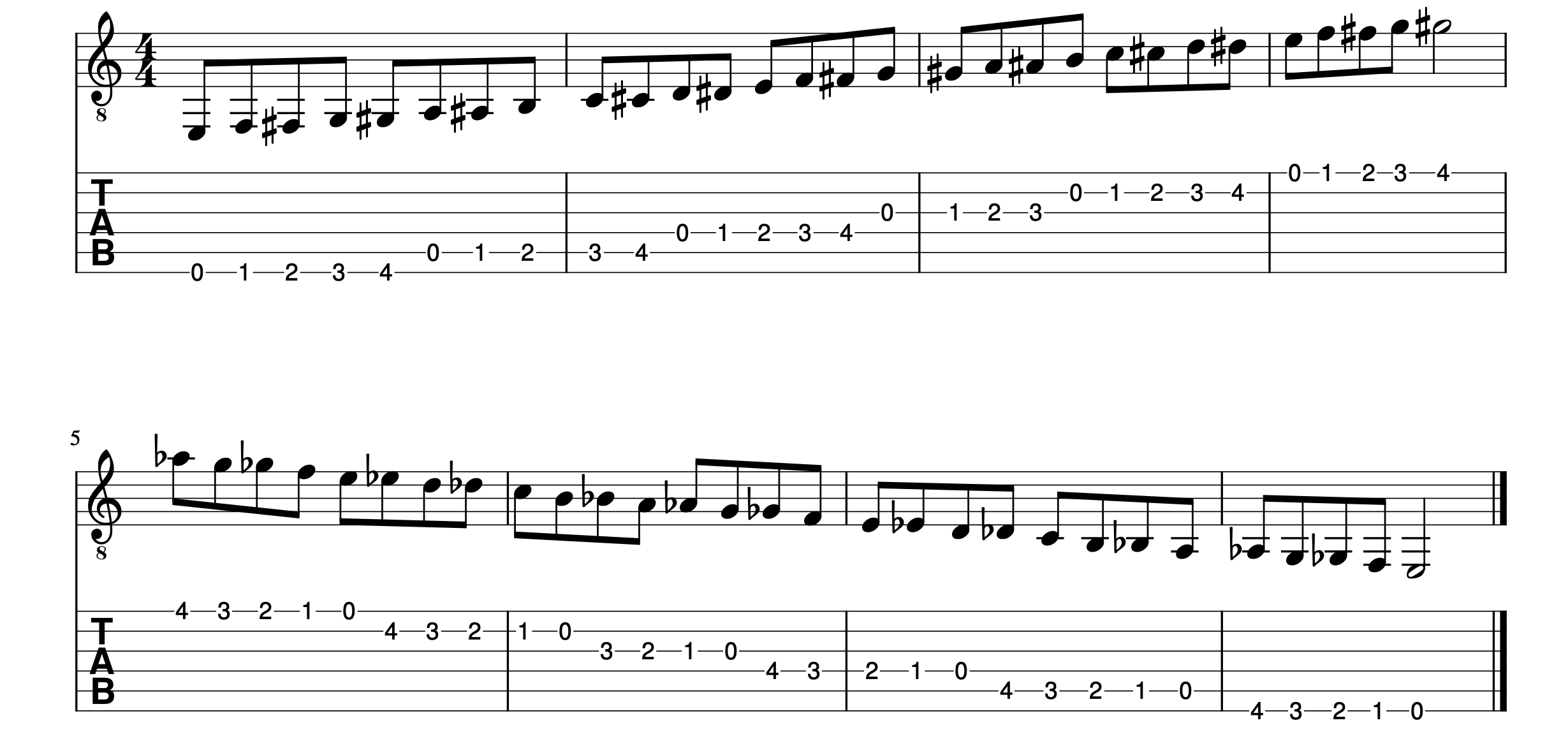
Before we play anything, let’s take a look at the palette that we’re working with. All of Western music is constructed by dividing the octave (the space between any frequency and that of twice it’s rate of vibration) into 12 tones, or half steps. On the guitar a half step is represented by a single fret. On the following page we’re going to dive right in and play the 12-Tone Chromatic Scale in 1st Position. 1st Position means that with the left hand we’ll use the index finger on the 1st fret, middle finger on the 2nd fret, ring finger on the 3rd fret, & pinky on the 4th fret. Here we’ll find all of the notes that we need to express anything in the musical Universe!
Tab Notation is the easiest way to start reading music on the guitar. Each of six lines corresponds to a string on the guitar. The bottom line is the lowest string in pitch (or physically highest) on the guitar, and the top is the highest string in pitch (or physically lowest) on the guitar. The strings from lowest to highest in pitch are Low E, A, D, G, B, High E. The number shown on each line indicates the fret that you will play on that string. 0 means to just play the open string by itself.
For the following exercise, don't worry so much about playing in time. Instead focus on getting a good tone from each note. The challenge here is to let each fretted note ring as clearly as an open string would.
When playing this exercise use alternating down and then up strokes with the pick. If you're using the fingers, alternate between strokes of the index and middle fingers.
Keep the left hand fingers in a position where they are ready to play the note that is coming next. You can almost let them hover over the next fret in the resting position. The tendency is often to pull them away from the fretboard, or let them move around in uncontrolled ways. You can see an example of this in the video below. We’ll explore this more in the upcoming lessons.
You may have noticed that we always play up to the 4th fret before reaching the next open string, except for on the B string. On the B string we play up to the 3rd fret before playing the next open string. This is because the interval between the B & High E strings is one half step lower than the interval between all other strings. This will present with some unique challenges down the road. Until then, just keep it in mind!
Play a melody of your own, as simple or complex as you’d like. Try to really “hear” each note in your head before you try to play it on the guitar. If needed, sing it out first. Record this melody as a video or voice memo on your phone.